


Most local media plans are built backwards.
The advertiser names a budget. The seller proposes a channel mix based on what’s worked before. The campaign launches. Everyone hopes the numbers come in close to what was implied. If they don’t, the conversation in week three gets uncomfortable.
This is how most local digital advertising still works, and it leaves money on the table at every stage. Advertisers under-commit because they don’t trust the projections. Sellers over-promise because they don’t have data to push back. Renewals get harder because the original conversation was based on intuition, not modeling.
There’s a better way, and it’s not new — it’s just been hard to access at the local level. It’s called forecasting, and the only thing standing between most local media organizations and using it well is a forecasting tool that actually works for the way they sell.
What forecasting answers
A real forecast answers three questions before a single dollar is spent.
The first is reach. Given the geography, audience, and budget the advertiser is considering, how many unique households will this campaign actually reach? Not “up to” or “approximately” — a real projection grounded in available inventory.
The second is frequency. How often will those households see the message? This matters because too little frequency wastes the spend and too much wastes it differently — saturating the same audience instead of expanding it.
The third is allocation. What’s the right channel mix to hit the goal? CTV-heavy for awareness? Blended for reach plus quality? FAST-weighted for cost efficiency? The right answer depends on what the advertiser is actually trying to do, and the forecast surfaces the tradeoffs in numbers instead of opinions.
A seller who can answer these three questions before the campaign starts is having a fundamentally different conversation than one who can only answer them after.
What changes when forecasting is in the seller’s workflow
The pitch changes first. Instead of “we recommend a $20,000 monthly budget across CTV, OLV, and display,” the seller can say: “with $20,000 a month, we project 240,000 unique households reached at an average frequency of 3.2 over the campaign window. If you want to extend that to 320,000 households, here’s what the budget looks like. If you want to keep the budget where it is but increase frequency to drive recall, here’s how the channel mix would shift.”
The advertiser hears something different. They hear modeling, not estimating. They hear tradeoffs, not pitches. They hear a partner doing the math, not a vendor selling a package. The credibility shift is significant, and it shows up in close rates.
The objection-handling changes second. The most common SMB objection to a media plan is “that’s more than I want to spend.” Without a forecast, the seller’s only response is to negotiate the price. With a forecast, the seller can show what the lower budget actually delivers — and let the advertiser make the choice on real numbers. Sometimes the advertiser stays at the lower budget and the campaign launches with realistic expectations. Sometimes they move up because they can see what the additional spend actually buys. Either way, the conversation is grounded in modeling instead of haggling.
The renewal changes third. When a campaign was launched against a forecasted projection, the renewal conversation has a built-in benchmark. Did the campaign deliver against the projection? If yes, the case for renewal is straightforward. If not, the conversation is about why — which is a far more productive discussion than an open-ended “did this work for you?”
What’s available in the platform
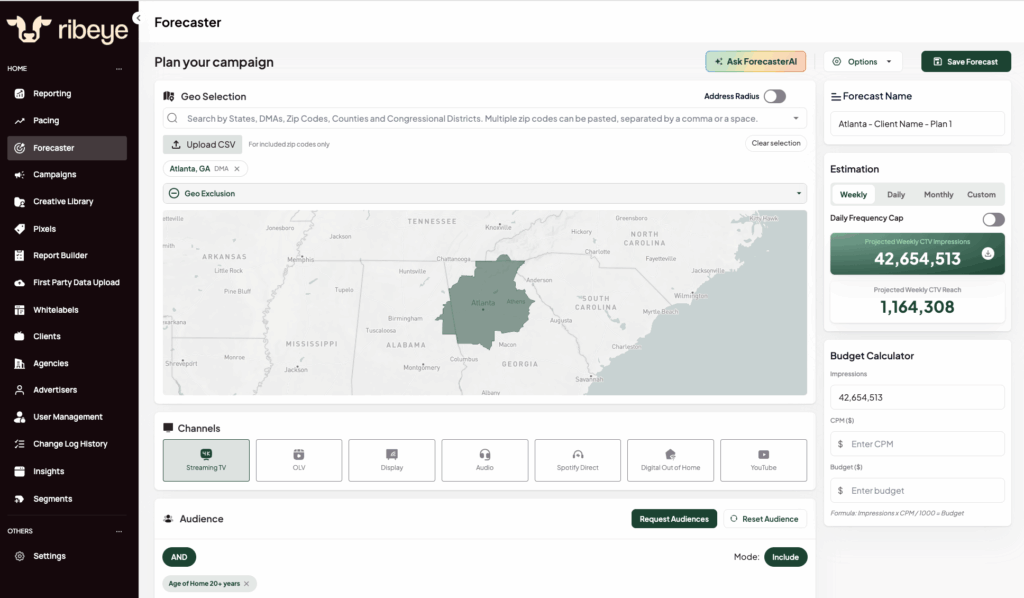
Ribeye’s Forecaster covers the channels that matter for local: Streaming TV, OLV, Display, Audio, Spotify Direct, Digital Out of Home, and YouTube. It models reach and frequency by geography (DMA, zip code, or custom radius), audience segment, and budget. As of the January 2026 release, the audio bucket includes hundreds of audience segments — the same depth that’s available in the other core channels — so audio can be planned alongside CTV and display rather than as an afterthought.
The Spotify Direct bucket gives a separate forecast view for premium Spotify Podcast inventory, which runs through a different supply path and needs to be modeled separately. For sellers whose rate cards include Spotify pricing, this means premium audio inventory can be forecasted and proposed cleanly instead of being treated as a custom request every time.
For sellers who want to move faster, the Planner AI generates full-funnel media plan ideas and maps audiences to the right geographic level. The seller stays in control of the plan — the AI is doing the assembly work, but it can also do the recommending.
The strategic argument
Forecasting isn’t a feature to be checked off. It’s a posture about how local media should be sold.
The advertisers who matter most — the ones with real budgets, real expectations, and the potential to renew and grow — want to be sold to with rigor. They want to see modeling. They want to understand tradeoffs. They want to know what their money is buying before they commit it.
For most of digital advertising’s history, that level of rigor was reserved for national buys. Local buys got estimates. The orgs that close that gap — that bring forecasting into every advertiser conversation, even the small ones — change how their advertisers experience them. They stop being a vendor that runs ads and start being a partner that plans campaigns.
That shift is worth more, over time, than any single feature. And it starts with a forecast.

