

Local media doesn’t have a demand problem. It has a plumbing problem.
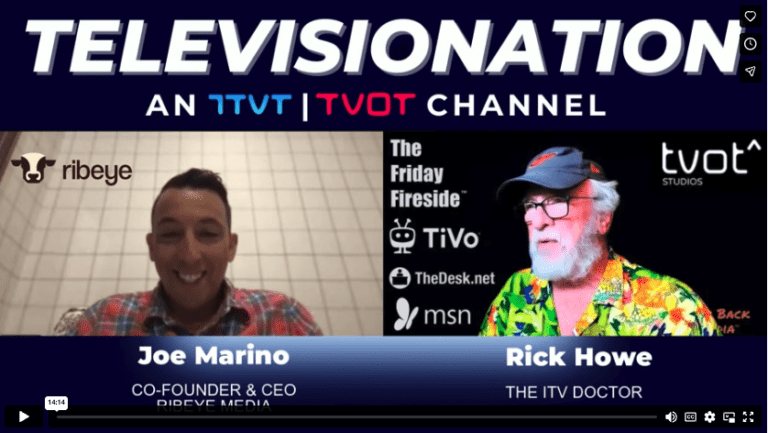
That was the throughline when Ribeye Co-Founder and CEO Joe Marino sat down with ITVT’s Televisionation: Friday Fireside — his first major conversation since Ribeye was named “Most Significant Newcomer” at the 22nd Annual ITVT/TVOT Awards in Montreal.
In 14 minutes, Joe lays out why the local market is so hard to operate today, and what it takes to fix it.
Watch the full Friday Fireside.
“We like to think of ourselves as the operating system for local.”
Ask Joe what Ribeye does and the answer is simple. Anyone executing media in the local market — local agencies, broadcast groups, media sales organizations — has to plan, buy, pace, optimize, report, attribute, and bill across an enormous range of channels: CTV, OTT, online video, display, audio, digital out-of-home, walled gardens, plus search, social, linear, and radio.
Doing all of that today means logging into and “swivel-chairing” across 15 or more systems.
Ribeye’s point of view: in 2026, that can be one unified platform.
“You need to plan across all of that, buy across all of that, pace, optimize, report, attribute, and then bill. Our point of view is that a lot of that can be consolidated into one platform — the operating system for local.” — Joe Marino
Why now: consolidation is forcing the issue
Local broadcast groups have been merging for decades. Every time companies come together, so do their tech stacks — different vendors, different tools, duplicate teams, duplicate workflows. The end goal is always the same: run operations more efficiently.
That’s exactly the moment Ribeye is built for. As groups re-evaluate their stacks, they’re consolidating onto fewer platforms — and looking for partners who can bring planning, buying, and reporting into one place so their teams can move faster.
The differentiator: integrations measured in days, not months
Bringing a new SSP or DSP online has historically taken three to six months. Ribeye does it in three days — and the near-term target is three hours.
The reason: Ribeye translates the data and nomenclature from any system into one common language inside the platform. So a YouTube (DV360) buy and a Hulu CTV buy — one walled garden, one open web, each with its own reporting and naming — can finally be read apples-to-apples, with de-duplicated reach across both.
“We can translate all of the information from System A into our own language, so our users can use it apples-to-apples. That’s a lot of work — and it’s what we do really, really well.” — Joe Marino
The proof point: 75 vendors → a plan in two minutes
The clearest example Joe shared on air:
A local group came to Ribeye with 75 vendors. It took them two weeks to build a plan and another two weeks to go live in digital.
On the Ribeye platform, they built a plan in two minutes — and went live the same day.
A month of work, waiting, and report aggregation collapsed into a 24-hour turnaround.
Local media companies have become agencies
The Nexstars, Tegnas, Sinclairs, Grays, and Scripps of the world aren’t just broadcasters anymore — they’re media companies running streaming channels, pushing news across aggregated and social platforms, and selling far beyond their owned-and-operated inventory.
A huge share of what they sell is now reach extension — non-O&O inventory, email, social, and search. They’ve effectively become agencies, with large sales teams calling on local businesses every day.
That’s why they need a platform they can white-label — one place that lets their sellers move fast instead of waiting on buys and requests to crawl through a chain of handoffs.
Built for the moments that matter: election season
In local political advertising, the last 48 hours before an election are everything. Under-deliver a campaign and that money is simply gone.
Ribeye works through the media companies who serve candidates, parties, and PACs — helping them turn around first-party voter files in hours instead of weeks, and clearing the extra layers of political approvals required by platforms like YouTube, Hulu, and Peacock. The result: campaigns get live faster and deliver in full.
What’s next:
Looking at 2026 and 2027, Joe previewed the next generation of the platform rolling out to clients in the back half of the year. It’s cleaner, with faster integrations and the full media gamut, from traditional non-digital all the way through search and social.
The biggest leap: users will be able to set up their own integrations on the fly. Want The Trade Desk here, GAM and FreeWheel for your owned-and-operated, StackAdapt and Simplifi for everything else? Pick and choose your own, and see exactly how each is performing — almost like choosing apps on your iPhone.
“2027 just looks like flooring it — getting in front of as many broadcasters, radio groups, and newspaper groups as possible. Half the market knows who we are. Half doesn’t.” — Joe Marino
We intend to change that.
Watch the full conversation
Joe’s full Friday Fireside with ITVT is available here.
Curious what one platform could do for your team? Let’s talk.

