

If you ask local media executives what keeps them up at night, you’ll hear familiar answers: fragmented workflows, too many vendors, disconnected systems, and increasing pressure to prove results for advertisers. The instinctive response is often the same: modernize the ad tech stack. It’s an understandable impulse. New technology promises automation, AI, unified workflows, and operational efficiency. Vendors promise fewer manual processes, better reporting, and faster campaign execution. But before issuing an RFP or beginning another platform evaluation, there’s a more important question to answer: How does revenue actually move through your organization?
Technology Doesn’t Fix Broken Processes
Too many modernization projects start by evaluating features instead of understanding operations. Questions like, “Can this platform support CTV? Does it integrate with our CRM? Does it automate trafficking? And does it have AI reporting?” are worth asking. But they assume the existing revenue process is already optimized. In many organizations, it isn’t. Sales teams use one system to manage opportunities. Operations use another to build campaigns. Digital specialists work in separate platforms. Reporting lives somewhere else. Finance has its own workflow. Every handoff introduces delays, duplicate work, and opportunities to lose information. Adding another technology layer rarely solves those problems. It can even make them harder to see.
Your Revenue Cycle Is Your Competitive Advantage
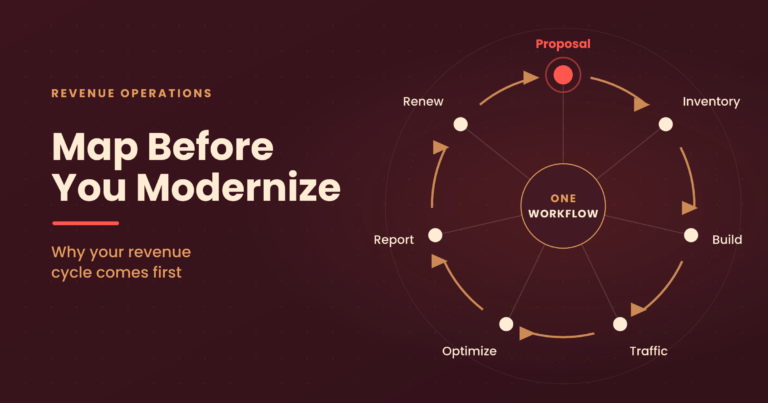
Big or small, modern local media companies compete on how easily advertisers can do business with them. That experience begins with proposal creation, and continues through inventory selection, campaign building, trafficking, optimization, reporting, and renewals. Every step affects the speed with which revenue moves through the business, and the confidence with which advertisers invest again. When those stages operate independently, customers can eventually feel the friction. And that kind of friction can eventually slow revenue growth.
Map Before You Modernize
Before evaluating another platform, map every step of your revenue cycle. Ask simple questions:
- Where does work stop waiting for another department?
- Where are people re-entering the same information?
- Which reports require manual spreadsheets?
- Which campaigns require multiple systems to launch?
- Where do advertisers experience delays?
- Where does data become inconsistent?
Most organizations are surprised by what they discover. The biggest bottlenecks often stem from disconnected workflows.
AI Is Only As Good As the Process Around It
Artificial intelligence is becoming an important part of advertising operations. It can summarize reports, generate insights, recommend optimizations, and so on. But it can’t eliminate organizational fragmentation. If campaign information lives in six different systems with different definitions and inconsistent data, AI simply processes the confusion faster. The organizations that benefit most from AI will be those that simplify the workflow.
Modernization Should Simplify, Not Multiply
The goal of modernization is to remove friction. Every new platform should reduce the number of systems employees touch, shorten campaign turnaround times, improve reporting consistency, and make buying local media easier for advertisers. If technology doesn’t improve the revenue cycle, what’s it for?
Think Workflow First
Local media has no shortage of technology, but it often lacks operational alignment. Before investing in another platform, map the way revenue actually flows through your organization, from first conversation to campaign renewal. Only then should you ask how well your technology supports the process. The broadcasters that outperform over the next decade will have the simplest, most connected revenue operations.
Frequently Asked Questions
What should local media do before modernizing their ad tech stack?
Map the revenue cycle first. Before evaluating platforms, document every step from proposal to renewal — inventory selection, campaign building, trafficking, optimization, reporting — and find where work stalls, data breaks, or information is re-entered. Technology can’t fix a broken process; it only runs the confusion faster.
Why do ad tech modernization projects fail in local media?
Most start by evaluating features instead of understanding operations, assuming the existing revenue process is already optimized. When sales, ops, digital, reporting, and finance each live in separate systems, every handoff adds delay and lost information — and a new tech layer often makes that fragmentation harder to see, not easier.
How does AI affect ad operations for local media?
AI can summarize reports, surface insights, and recommend optimizations, but it can’t eliminate organizational fragmentation. If campaign data lives in six systems with inconsistent definitions, AI just processes the confusion faster. The companies that get the most from AI are the ones that simplify the workflow first.

