

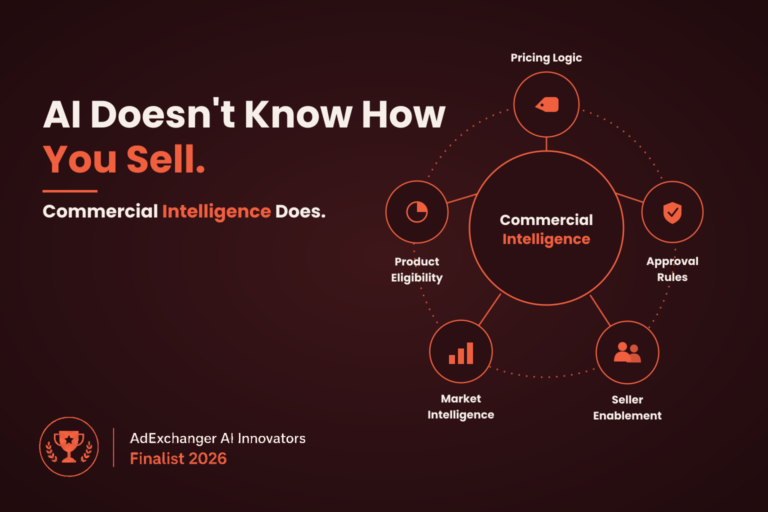
AdExchanger has named Ribeye a finalist in the AI Innovators category, for our entry: Ribeye — AI-powered revenue acceleration and ad operating system built for local media. Winners are announced September 28 at the Awards gala during Programmatic I/O in New York.
We’re proud of it. And what we’re proudest of is who we built it for. The recognition is less about the AI itself than about where we aimed it—and about what sits underneath it, which is the part almost nobody in this category is talking about.
Why AI in Ad Sales Needs Structured Commercial Rules
AI in a revenue organization is only as good as the commercial rules underneath it. Without them, it isn’t recommending. It’s guessing.
Nearly every company in this category shipped an AI feature in the last eighteen months. Very few have anything structured beneath it. An AI that doesn’t know your pricing floors, your approval thresholds, or which products a client actually qualifies for in a given market will guess fluently, confidently, and faster than any human reviewer can keep up with. Automation without commercial intelligence beneath it doesn’t fix your process. It runs your mistakes faster.
So the real question isn’t whether your platform has AI. It’s whether anything in your organization has ever written down how you actually sell.
What Is Decision Drag in Local Media Sales?
Decision drag is the time and margin a media company loses re-litigating pricing, product, and approval decisions that someone in the organization has already made.
Every media company has a version of the same person. Twenty years in the market. Knows which product to lead with for a home services advertiser in a soft third quarter. Knows what that account will actually clear at, not what the rate card says. Knows who has to sign off before a discount goes out the door.
That knowledge is the business. It’s also undocumented.
So every deal starts over. A newer seller builds a proposal, sends it up, gets it back with corrections, revises. A pricing question sits in an inbox. An avail gets checked three times by three people. The advertiser waits — and somewhere in that gap, someone else’s proposal shows up first. It’s one of the most expensive line items in local media revenue operations, and almost nobody has it on a report.
Why Standardizing Your Sales Process Backfires
Standardizing how everyone sells removes the inconsistency and the competitive advantage at the same time.
The instinct in software is to treat all that variation as a defect. Same template, same workflow, inconsistency gone. So is the edge. Your pricing logic, your approval structure, your product mix, your market-by-market realities — those aren’t inefficiencies. They’re how you win, and they’re different from how the group two markets over wins.
We built Ribeye on the opposite premise. The goal isn’t to standardize how you sell. It’s to structure it.
What Is Commercial Intelligence?
Commercial Intelligence is what happens when your commercial playbook — pricing logic, product eligibility, approval structure, market-level rules — stops living in people’s heads and starts living in the system that runs your business. In plain terms: it learns how you sell.
Set a rule once and it applies the same way for every seller, every market, every proposal. What used to be tribal becomes inheritable. What used to walk out the door with a retiring AE stays. And because that knowledge is finally structured, AI has something real to work from instead of a guess.
Should AI Set Pricing in Media Sales?
No. The system drafts and ranks. People price and approve.
We’re deliberate about that ordering, and we say it out loud because it’s a design decision, not a disclaimer. Once your rules are explicit, a recommendation can be checked against them, and every recommendation can explain why it’s a recommendation. That’s what makes AI genuinely usable in a revenue organization — not more autonomy, but enough structure that a human can trust what they’re looking at and move faster because of it.
What’s Next for Ribeye’s Commercial Intelligence
More is coming this fall.
We’re not going to preview the mechanics — partly because we’d rather show it than describe it, and partly because the mechanics were never the hard part. Any competent team can put a model in front of a workflow. The hard part is the structured commercial layer beneath it, and we learned that from years of building alongside local media teams who told us, repeatedly, that the problem was never a lack of tools. It was that none of their tools understood how they actually sell.
Ribeye is the AI-powered revenue acceleration and ad operating system built for local media. Designed for broadcasters, agencies and media sales organizations, Ribeye unifies prospecting, proposal generation, campaign execution, reporting and optimization in one system. By combining local market intelligence, automation and real-time performance visibility, Ribeye helps sellers move faster, reduce operational complexity and generate more revenue across streaming TV, digital programmatic, walled-gardens, owned media and emerging channels.

