

The full-funnel conversation in advertising is usually framed for big brands with big budgets. CTV awareness campaigns, OLV consideration plays, display retargeting, dynamic creative across every stage. It’s a beautiful picture, and it’s not the picture most local sellers are working with.
Most local sellers are working with SMB advertisers whose monthly budgets range from $2,500 to $25,000. They want results. They want to grow. They don’t have agency partners running their media. And they’re skeptical — rightly — of any plan that looks like it was designed for someone bigger.
But full-funnel advertising isn’t only for big budgets. It’s a strategic approach that works at any spend level, as long as the plan is built realistically for the budget that’s actually on the table. The mistake isn’t running full-funnel for SMBs. The mistake is pretending an SMB budget can do everything an enterprise budget can do.
Here’s how full-funnel planning actually works at SMB scale.
Start with the goal, not the channels
Full-funnel doesn’t mean “every channel.” It means awareness, consideration, and conversion all working together. For an SMB, that often means picking one or two channels for each stage — not every channel in the funnel framework.
An urgent care clinic with a $7,500 monthly budget might run CTV for awareness, display for consideration, and retargeting display for conversion. That’s full-funnel. It hits all three stages. It doesn’t try to also run OLV, audio, DOOH, and YouTube — because that budget can’t support meaningful presence in every channel.
A medical aesthetics clinic with a $15,000 monthly budget might add OLV for consideration and audio for top-of-funnel reach. That’s full-funnel with more depth at each stage.
The principle is the same: identify what each stage of the funnel needs to do for this advertiser, and pick the channels that do it best at the budget available.
How budget allocation actually works
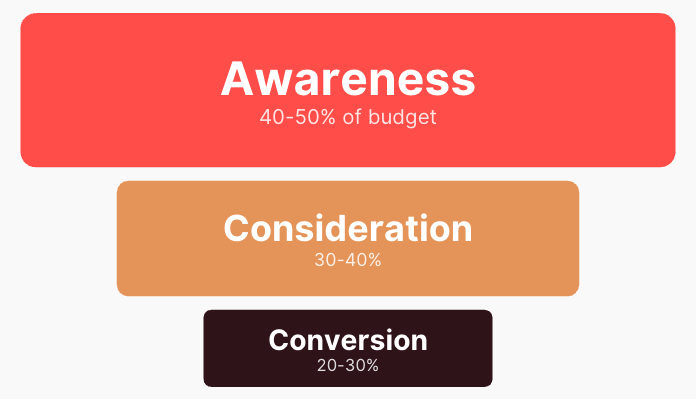
There’s no universal rule for how to split budget across the funnel, but there’s a useful starting point: roughly 40-50% awareness, 30-40% consideration, 20-30% conversion. Adjust based on the advertiser’s situation.
An advertiser who’s brand-new to the market needs more awareness weight. An advertiser with strong existing brand recognition can shift more to consideration and conversion. A seasonal advertiser with a tight window of demand might compress the funnel and weight conversion heavily.
The Forecaster makes these allocations testable. The seller can model different splits and see what each delivers in terms of reach and frequency. The advertiser sees the tradeoffs in real numbers.
The trap to avoid
The most common mistake in SMB full-funnel planning is over-spreading. The seller, trying to be helpful, includes every channel — a little CTV, a little OLV, a little display, a little audio, a little DOOH. The plan looks comprehensive. In practice, it delivers underweight presence across every channel and meaningful presence in none.
A campaign with $1,500 a month in CTV doesn’t have enough frequency to drive recall. A campaign with $1,500 in OLV doesn’t reach enough households to matter. A campaign with $1,500 in audio is a rounding error. Spread an SMB budget too thin and the result is a plan that looks like a full-funnel campaign but actually isn’t.
The discipline is to run fewer channels well. Two channels with meaningful weight beat five channels with token presence. The Forecaster surfaces this — when a channel allocation is too small to be effective, the projected reach and frequency reveal the problem before launch.
Vertical patterns that work
Different SMB verticals have natural full-funnel patterns. A few examples drawn from real campaign types:
Healthcare (urgent care, clinical research, medical aesthetics): CTV awareness in the service area, display for consideration with treatment-specific creative, retargeting display for users who visited the booking page. Add audio for higher-budget campaigns. Geography typically tight — radius around the location.
Home services (HVAC, roofing, landscaping): DOOH and CTV for neighborhood awareness, display for consideration with seasonal offers, retargeting display for site visitors. Geography defined by service area, often layered zips.
QSR (quick-serve restaurants): CTV and audio for awareness around new menu items or LTOs, OLV with food creative for consideration, geo-targeted retargeting display for nearby customers. Geography tight to the location radius.
These aren’t templates. They’re starting points. The actual plan depends on the advertiser’s specific situation, but the patterns help sellers think structurally about what each vertical’s funnel needs to do.
The longer-term play
The biggest argument for SMB full-funnel isn’t what it does in month one. It’s what it does in month six.
An SMB advertiser running a single channel — usually retargeting or search — is playing only at the bottom of the funnel. They’re capturing demand that already exists. When that demand pool runs out, growth stalls. The advertiser blames the channel. The seller loses the renewal.
An SMB advertiser running full-funnel is building demand at the same time they’re capturing it. Awareness creates new prospects. Consideration nurtures them. Conversion captures them. The pool keeps refilling. Growth compounds.
Selling this story is easier when the seller can show the advertiser a forecast that models the full funnel, not just a quote for a retargeting campaign. The plan tells the story. The numbers make the case. The advertiser sees a strategy, not a media buy.
Full-funnel for SMBs isn’t a luxury. It’s the difference between a one-month campaign and a 12-month relationship. Plan it well at any budget and the math works.
If you want to see how Ribeye’s Forecaster can help you plan your campaigns, contact us for a demo!

