

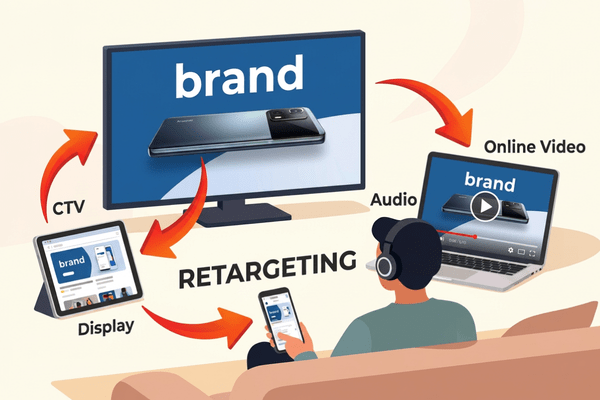
Local digital campaigns have always been built channel by channel. CTV, display, audio, and OLV each came with their own pixels, audience definitions, and retargeting infrastructure — so even the best sellers ended up running parallel channels on a shared calendar rather than a single coordinated campaign. Cross-channel retargeting is what closes the gap. When every part of the buy knows what came before it, the campaign stops being a series of impressions and starts being a journey.
Key takeaways
- Cross-channel retargeting uses ad exposure on one channel (e.g. CTV) as a targeting signal on another (e.g. display or audio). It’s distinct from site visit retargeting, which is triggered by an action on the advertiser’s website.
- Most local digital campaigns still run as siloed channels on a shared calendar. A connected buy turns them into a coordinated funnel — awareness, consideration, conversion — across CTV, OLV, display, and audio.
- The unlock is a shared data layer: one pixel across every channel, exposure data flowing between channels, audiences defined across the buy rather than within each silo.
- A connected buy produces three measurable changes: better efficiency, real sequencing, and reporting that shows households moving through the funnel.
- National platforms have offered this for years. Local sellers who can match it — in a self-serve workflow — close the structural gap with the platforms.
The problem with siloed channels
A household sees a CTV spot for an urgent care clinic on Monday night. On Wednesday, someone in that household searches symptoms on a laptop and clicks through to the clinic’s website. Friday, they hear a streaming audio ad — but it’s a different advertiser entirely. Or it’s the same clinic, but the ad has no awareness that the household has already seen the CTV spot, visited the site, or done anything else.
This sequence repeats constantly in local digital advertising. Each channel optimizes within itself. The CTV buyer optimizes CTV reach. The display buyer optimizes display performance. The audio buyer optimizes audio delivery. None of them is talking to each other. The advertiser pays for impressions across every channel, yet gets a sequence of disconnected touches rather than a coherent journey.
Retargeting fixes this — but “retargeting” in local digital is doing more work than the word suggests, and it’s worth pulling apart what’s actually in it.
What is site visit retargeting?
Site visit retargeting is action-based retargeting that uses a pixel on the advertiser’s website to capture visitors and re-engage them across the rest of the media buy. Someone who visited the urgent care clinic’s site can be served a follow-up display ad, an OLV ad, an audio ad, or a CTV impression.
This is the kind of retargeting most advertisers are familiar with — the classic “ads following you around the internet” capability, extended to channels beyond display.
The trigger is an action: the household did something on the advertiser’s property, and the rest of the buy follows up.
What is cross-channel ad-exposure retargeting?
Cross-channel ad-exposure retargeting is exposure-based retargeting that uses an ad impression on one channel as a targeting input on another. A household exposed to a CTV ad becomes a retargetable audience on display and OLV. A display clicker becomes retargetable for video. Audio listeners can be re-engaged across the rest of the buy.
The trigger is exposure, not action: the household was reached on one channel, and you’re reinforcing on another — without needing them to visit the advertiser’s site first.
Site retargeting vs. cross-channel retargeting: what’s the difference?
These two work very differently:
- Site visit retargeting is action-based. The household took an action, and you’re following up.
- Cross-channel retargeting is exposure-based. The household was reached on one channel, and you’re reinforcing on another.
Used together, they’re the difference between a media buy and a campaign.
Why this has been hard for local media sellers
For most of local digital’s history, both forms of retargeting were constrained. Channels ran in separate ecosystems, with separate pixels, audience definitions, and retargeting infrastructure. Display and OLV worked together reasonably well. Everything else — CTV, audio, sometimes even basic video — was an island.
The unlock is when channels share a data layer: when the same pixel fires across CTV, OLV, display, and audio; when ad exposure on one channel can be used as a targeting input on another; when the seller can build a journey rather than hope the channels add up.
How Ribeye enables a connected buy
Ribeye is purpose-built for this. A single pixel covers the full channel set — CTV, OTT, online video, display, and audio. Exposure data flows between channels. Audiences are definable across the buy, not within each silo. And the entire workflow is self-serve, so a local seller can build, traffic, and optimize a connected campaign without an agency or managed-service team.
The platform consolidates planning, activation, optimization, and reporting into one login, one workflow, one source of truth — which is what makes cross-channel retargeting operationally practical instead of theoretical.
How does a connected buy change campaign performance?
When site visit retargeting and cross-channel retargeting work across the same channel set, three things change about how the campaign actually performs.
1. Efficiency
When channels can retarget each other, every impression after the first is more valuable because it reinforces prior exposure or prior action rather than restarting from zero. The same media spend produces a more cumulative effect on the same household.
2. Sequencing
The seller can build campaigns that reflect how the funnel actually works:
- Awareness on CTV.
- Consideration on OLV and display, retargeted to CTV viewers.
- Conversion on display and audio, retargeted to site visitors.
- Audio woven in for added frequency at every stage, against both exposure-based and site-based audiences.
This is the kind of campaign that used to require a national agency and a managed-service trafficking team. It can now be built by a local seller in a self-serve workflow.
3. What the seller can credibly claim
“We ran across CTV, display, and audio” describes a calendar. “We retargeted your CTV viewers across display and audio, and we re-engaged your site visitors with audio and OLV” describes a campaign working as an integrated system. Advertisers feel the difference, and the reporting reflects it.
What the advertiser actually gets
From the advertiser’s seat, a connected buy changes what they’re buying. They’re no longer paying for a series of separate channel placements that happen to share a calendar. They’re paying for a coordinated journey for their audience, with reinforcement built in at every step.
The reporting reflects this. A campaign with both kinds of retargeting in play produces data that shows how households moved through the funnel — exposure on CTV, follow-on engagement on display, site visit, conversion via audio or retargeting. That’s a story the advertiser can understand and act on. It’s also a story that supports renewal, because it shows the campaign working as a system rather than as a collection of impressions.
Why this is a competitive advantage for local media
The major national platforms have offered this kind of connected buy for years. It’s part of why they win larger budgets. Local media organizations that can’t offer the same thing are at a structural disadvantage in every conversation where the advertiser is comparing options.
The organizations that can offer it — and offer it in a self-serve workflow — have something genuinely hard to replicate. The relationships, the local content, and the trusted audiences have always been the local advantage. Retargeting across the full buy is what lets those advantages translate into the kind of campaign sophistication advertisers now expect.
The capability exists. The advantage goes to the sellers who build with it.
Frequently asked questions
What is cross-channel retargeting?
Cross-channel retargeting is the practice of using ad exposure on one channel as a targeting signal on another. A household that sees a CTV ad becomes a retargetable audience on display, OLV, or audio — without needing to take an action on the advertiser’s website first.
How is cross-channel retargeting different from site retargeting?
Site retargeting is triggered by an action on the advertiser’s website (a pixel fires when someone visits). Cross-channel retargeting is triggered by an ad impression on another channel. Site retargeting is action-based; cross-channel retargeting is exposure-based. They’re complementary, not substitutes.
What channels can be connected in a cross-channel retargeting campaign?
In a unified platform like Ribeye, the connected channel set includes CTV, OTT, online video (OLV), display, and streaming audio — all sharing a single pixel and audience layer.
Why is cross-channel retargeting hard for local media sellers to offer?
Historically, each channel ran in its own ecosystem with its own pixel, audience definitions, and retargeting infrastructure. Without a shared data layer across channels, ad exposure on CTV couldn’t be used to target the same household on display or audio. A unified workflow with one pixel across every channel is what makes it operationally practical.
Does cross-channel retargeting require a managed-service team?
Not anymore. The historical assumption was that this level of campaign sophistication required a national agency and a managed-service trafficking team. With a unified self-serve platform, a local seller can build, traffic, and optimize a connected campaign directly.
What’s the business impact of a connected buy?
Three things change: efficiency improves because every impression after the first reinforces rather than restarts; sequencing becomes real, with awareness, consideration, and conversion stages running deliberately rather than incidentally; and reporting shows how households moved through the funnel, which is the kind of story that supports renewal.

