

By: Joe Marino, CEO and Founder
Most local media reporting still happens in a spreadsheet.
Not because anyone wants it to. Because the data lives in different places. CTV reporting in one platform, display in another, audio in a third, search and social in their own walled gardens. To answer the simplest possible advertiser question — “how did the campaign do?” — someone has to pull each report, normalize the metrics, reconcile the discrepancies, and assemble the picture by hand.
That work takes hours. Sometimes days. And the version that lands in front of the advertiser is always one or two days old by the time it arrives.
This is one of the largest hidden costs in local media operations, and it’s the cost an omnichannel reporting layer is designed to eliminate.
What omnichannel reporting actually means
The phrase “unified reporting” gets used loosely. In practice, it can mean three very different things.
The weakest version is a single login that lets you click through to different reports for different channels. The data is still siloed; you’ve just consolidated the bookmarks.
The middle version is a dashboard that aggregates summary metrics from each channel into one view. Useful for high-level pacing, but the moment you want to ask a real question — how did this audience respond across channels, what was the cross-channel frequency, what’s the actual reach when you account for overlap — you’re back in the underlying systems.
The strongest version, and the one that matters, is a reporting layer where every channel produces data into the same model, with the same definitions, in the same view. CTV impressions sit alongside OLV impressions sit alongside display impressions sit alongside audio impressions, and they all mean the same thing. Reach is calculated across channels, not within each. Conversions are attributed without manual stitching. Pacing reflects the entire campaign, not one line item at a time.
That’s the version that changes the seller’s day.
What it looks like in the platform
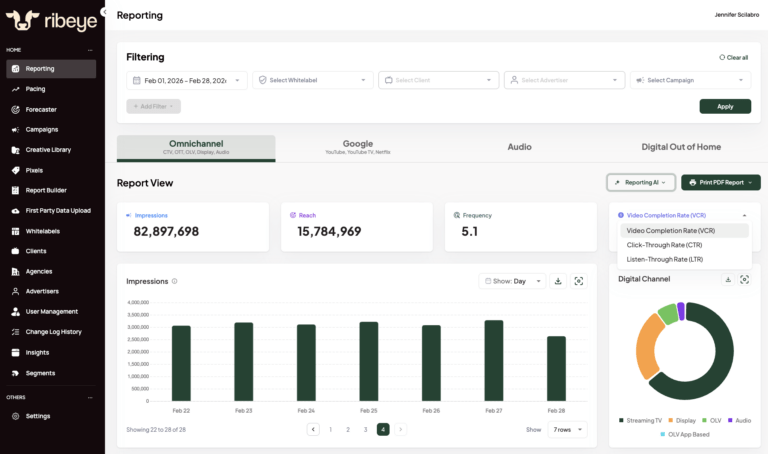
In Ribeye, the Omnichannel reporting tab now includes Streaming TV, OTT, OLV, Display, and Audio in one view. As of the January 2026 release, audio reporting joined the same tab — meaning a seller running a campaign across CTV, display, and streaming audio gets a single dashboard with unified impression counts, cross-channel reach and frequency, and shared conversion tracking via the standard pixel.
The same view shows pacing across every line item. Audio campaigns populate alongside the rest of the buy, not in a separate report. View-through conversions track from any channel — including audio, which historically has been the hardest channel to attribute.
Google products (YouTube, YouTube TV) live in their own tab because of the walled-garden constraint. Everything else — the channels that share a data layer — share a screen.
What this changes for the seller
The most immediate change is time. The reporting that used to take an afternoon to assemble takes minutes. The reconciliation work — the part where the seller chases down why one platform says 1.2 million impressions and another says 1.18 million — disappears, because the numbers come from the same source.
The second change is what the seller can confidently say. When every channel reports through the same model, the seller can answer questions they couldn’t answer before. What was the actual cross-channel frequency? Real number, not an estimate. How did the audience that saw the CTV ad behave when retargeted on display? Visible in the same dashboard. Which channel is doing the most efficient work for this advertiser? Comparable directly, not through translation.
The third change is the conversation with the advertiser. A seller who can pull up one dashboard and walk through a campaign’s full performance in three minutes is having a different meeting than one who arrives with five PDFs and a spreadsheet. The advertiser feels the difference. The renewal conversation gets easier.
The strategic stake
For local media organizations, omnichannel reporting isn’t a feature to evaluate — it’s a precondition for being competitive against national platforms that have it by default. National buyers expect to see a unified picture. Local advertisers don’t articulate that expectation, but they feel it when their reporting is fragmented and they read it as a credibility signal.
The orgs that solve this stop spending operational hours on reconciliation. Their sellers spend more time in front of advertisers and less time in spreadsheets. Their renewals happen on cleaner data. Their advertisers experience local media as a sophisticated partner, not a cobbled-together one.
That’s what the omnichannel dashboard delivers. Not a prettier report. A fundamentally different relationship with the advertiser, made possible by the work the data layer does underneath.

