

“Optimization” is one of the most overused words in digital advertising. Sometimes it means bid changes and creative rotation. Sometimes it means shifting budget between channels. And sometimes it just means “we’re still working on your campaign.” The word does a lot of quiet work covering for very different levels of effort.
But underneath the vagueness there’s a real distinction — two genuinely different kinds of optimization. Most local media organizations are only doing one of them, and it’s costing their advertisers performance nobody can see.
Within-channel vs. cross-channel: what’s the difference?
The first kind is within-channel optimization. The CTV buyer optimizes CTV. The display buyer optimizes display. The audio buyer optimizes audio. Each channel gets tuned based on what’s working inside that channel. This is necessary work, and it should keep happening. But on its own, it’s incomplete.
The second kind is cross-channel optimization. Here the campaign as a whole gets adjusted based on what’s working across the entire buy. Budget moves between channels based on relative performance. Frequency gets balanced across the household, not the channel. Conversion contribution gets attributed across the buy instead of siloed inside it. This is what real optimization looks like — and it’s only possible when your channels share a reporting layer.
Why most local optimization stops halfway
When channels live in separate systems, cross-channel optimization is structurally hard. Think about what it takes to do it by hand: pull CTV from one system, OLV from another, display from a third, audio from somewhere else entirely. Then reconcile everything — confirm “reach” means the same thing in each place, that “conversion” is defined consistently, that the numbers cover the same window. Assemble a unified picture in a spreadsheet. Only then can you actually make a decision.
Now do that every week, for every campaign, while you’re also running a pipeline.
It’s not that local sellers don’t want to optimize across channels. It’s that the manual labor is enormous — and almost all of it is reconciliation, not decision-making. The seller’s time gets eaten assembling the data, which leaves almost none for the optimization itself. So multi-channel campaigns get plenty of within-channel tuning (because each system makes that easy) and very little cross-channel tuning (because the unified view simply doesn’t exist).
What changes when the reporting layer is shared
When your channels run on the same data model, the labor flips. There’s nothing to reconcile, because the data is already unified — so the seller spends their time on the decision instead of the assembly.
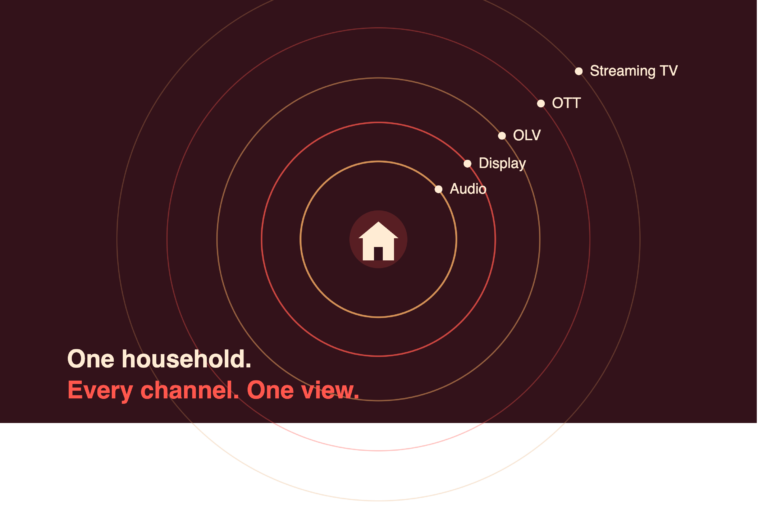
Inside Ribeye, the Omnichannel reporting tab pulls Streaming TV, OTT, OLV, Display, and Audio into a single view: same impression model, same deduplicated reach calculation, same conversion attribution through one pixel, same time window. The seller isn’t looking at a picture they stitched together. They’re looking at one that was already whole.
That’s what makes a different kind of optimization possible.
Three moves that only work with unified data
-
Budget reallocation by cost-per-outcome.
When every channel reports conversions through the same pixel and the same attribution model, you can compare cost-per-site-visit or cost-per-conversion directly across channels. If display is driving site visits at $4 and OLV is driving them at $9, moving budget toward display becomes a data-backed call instead of a hunch. The Insights and Reporting tabs make that comparison visible.
-
Frequency rebalancing across the household.
When the system sees how often a household has been reached across all channels, frequency optimization finally makes sense. A campaign hitting 12 average household impressions a week — too many — can shift budget away from over-frequenced channels and toward under-reached audiences. That’s impossible in a fragmented stack, because no single channel knows what the others are delivering to the same home.
-
Funnel-stage rebalancing.
Campaigns often launch with a fixed split — say 50% awareness, 30% consideration, 20% conversion — and then never move. With unified reporting you can see in week two whether awareness is feeding enough downstream activity, whether consideration is converting at the expected rate, and whether the original split still holds. Adjustments become evidence-based rather than intuitive.
What doesn’t change with cross-channel optimization
Cross-channel optimization doesn’t replace within-channel work — it sits on top of it. The CTV buy still benefits from creative rotation and audience refinement. The display campaign still benefits from creative testing and bid tuning. Within-channel optimization keeps each channel performing well. Cross-channel optimization makes sure the channels are actually working together, and that the budget is flowing to whatever is delivering against the goal.
The organizations doing both win. The ones doing only within-channel are leaving real performance on the table — because they have no way to see how the channels relate.
What this means for the seller
Done well, this changes what a seller can offer an advertiser.
The mid-flight check-in becomes a different conversation. Instead of “here’s how each channel is doing,” it’s “here’s how the campaign is doing, here’s where the budget is working hardest, and here’s how I’m shifting things to get you the best result.” That’s strategic. It positions the seller as a partner managing the campaign, not a vendor reporting on channels.
The end-of-flight conversation changes too. Rather than walking through channel-by-channel numbers, the seller explains campaign-level outcomes — and can credibly attribute them across the buy, because the data supports it. Renewal builds from there.
That’s what “optimization” means once your channels share a reporting layer. It isn’t a marginal upgrade to within-channel tactics. It’s a different kind of campaign management — strategic, unified, evidence-based — that your infrastructure either makes possible or makes impossible. The teams whose infrastructure supports it hold a durable advantage over everyone still running a fragmented stack.
That’s the half of optimization most of local media hasn’t gotten to yet. It’s the half that’s worth the most.
See also: The Connected Buy: How Retargeting Turns Disconnected Channels Into Campaigns

