

Today’s local media organizations are managing more channels and data than ever. In response, leaders have bolstered their tech stacks. Over time, though, this dynamic has forced sellers and operators to work across disconnected systems throughout the revenue cycle.
Now, these same organizations are looking for a better way to connect prospecting, planning, activation, reporting, billing, and customer data without replacing the technology in which they’ve invested—all so that sellers can spend less time navigating systems and more time moving opportunities forward.
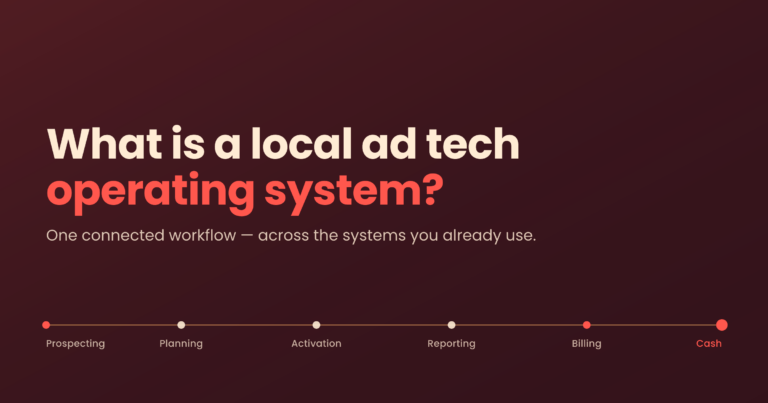
Thankfully, if CRMs, OMSs, DSPs, reporting platforms, billing systems, inventory management tools, and other technologies each solve an important operational problem, the ad tech operating system has emerged as a solution for connecting them. An ad Tech operating system is a unified layer that creates a single end-to-end workflow—from prospecting to cash—by giving sellers and operators one view of campaigns, customers, performance, and revenue.
To understand why this approach is gaining traction, let’s look at how an ad tech operating system differs from a traditional tech stack and what that means for local media organizations.
How is an ad tech operating system different from a traditional tech stack?
Traditional ad tech stacks consist of specialized platforms that each perform a specific function. A CRM manages customer relationships, an OMS handles orders, and a DSP activates campaigns, while reporting, billing, and inventory management live elsewhere.
An ad tech operating system sits across those systems to create a single, end-to-end workflow. Rather than replacing the technology organizations already use, the shared operating environment this approach yields allows sellers and operators to work from a single view of campaigns, customers, performance, and revenue.
The individual tools of a tech stack are stronger when they work together. Instead of information stopping and restarting as team members move between platforms, an operating system creates a single workflow for the entire process, from prospecting through planning, activation, reporting, billing, and ultimately to cash.
How does an ad tech operating system improve local media workflows?
Because local media organizations can be small, individual team members must often drive prospecting, planning, campaign activation, optimization, reporting, and account management, sometimes across dozens of advertisers.
However, when each of these steps requires switching platforms, reconciling reports, or manually gathering information, operational work begins to consume time that should be spent creating revenue.
Solving for this, ad tech operating systems give sellers faster access to the information they need to plan campaigns, answer client questions, identify opportunities, and understand performance. Sellers and operations teams can then work from a single view of customers, campaigns, data, and KPIs.
This shared visibility carries through planning, execution, optimization, and reporting, making every stage of the revenue workflow more efficient. It also creates a stronger foundation for AI-assisted planning and reporting, since those tools are most effective when they can draw from connected business data.
For local media organizations in particular, the resulting efficiencies create value beyond operations. Sellers can spend less time navigating systems and more time strengthening advertiser relationships and understanding local business needs to help their clients grow. That’s where local media has always differentiated itself, and an operating system frees up more time for that work.
How Ribeye transforms fragmented tech stacks into connected workflows
Ribeye was designed as operational infrastructure for local media. With our ad tech operating system, organizations can continue using the platforms they know and love, whether that’s Salesforce, DV360, a preferred DSP, an existing OMS, or another reporting solution.
This design stems from the reality that every local media organization operates differently. They may sell similar products while using different partners, DSPs, reporting platforms, and operational processes to deliver them. Ribeye was purpose-built with that flexibility in mind to provide a holistic, actionable view of campaigns, customers, reporting, and revenue with which local media organizations can simplify operations, improve seller productivity, and scale without needing to add even more disconnected systems.
An ad tech operating system doesn’t ask local media organizations to rebuild their technology stack. Instead, it enables them to maximize the value from the one they already have. If you’re looking to simplify operations by giving sellers a more connected way to work, reach out to us today for a demo.

